Hairqut.
HQ-STYLE-000048QA passed with warnings

Style · 360 waves

360 Waves with Low Taper and Natural Lineup

Short uniform natural hair trained into a concentric 360-wave pattern, with a visible crown whorl, low edge taper, and a clean natural lineup without painted enhancement.

Available as a mobile service at homes, offices, and hotels across Greater Montréal.

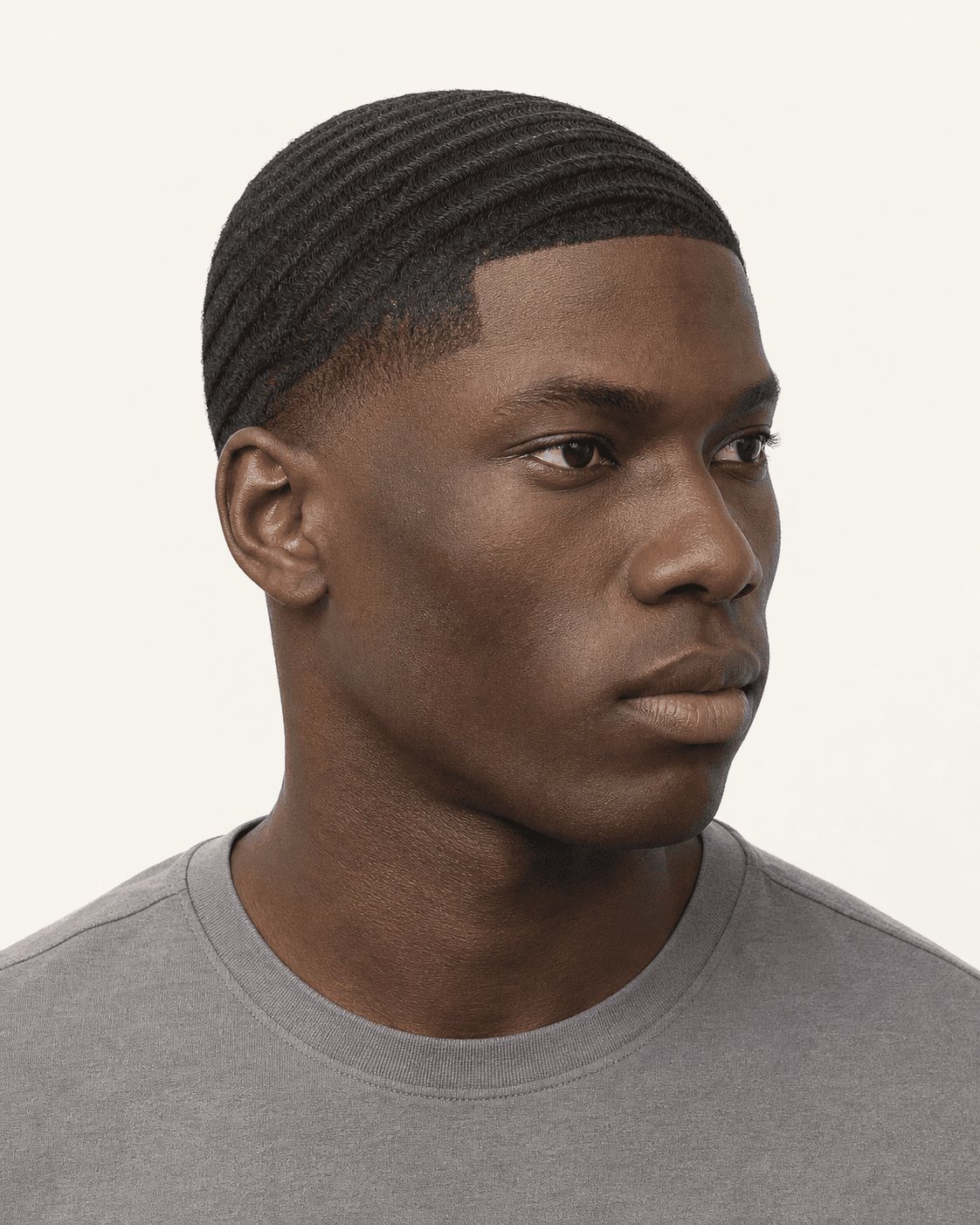
Three-quarter view of concentric 360 waves and a low taper
Interactive view4 verified angles

Three-quarter

20°

Drag to inspect the registered construction

Reference angle explorer

Drag or swipe · horizontal scroll or Shift + wheel · arrow keys

2 / 4

Fashion white · target #F2F0EA

Current documented coverage: four verified angles from 0° to 180°. A continuous 360° turntable publishes only after 24–36 consistent frames pass registry QA.

Showing three-quarter view at 20°.

Required registry views

One style. Four viewpoints.

A single portrait can hide the taper, fade height, crown, weight line, or neckline. Every published Hairqut record must show the construction from the front, three-quarter, side, and rear. The recorded fashion white backdrop keeps the silhouette readable while preserving fine strand detail.

Front view of 360 waves with a low taper and natural lineup
Front
Three-quarter view of concentric 360 waves and a low taper
Three-quarter20°
Side profile of 360 waves showing the wave flow and low temple taper
Side90°
Rear view of 360 waves showing a centered crown whorl and low nape taper
Rear180°

Hairqut Style Blueprint · Style construction

A visual brief your professional can use.

The registered views establish the reference. This blueprint pins the most important construction decisions directly to those source views, then makes adaptation, maintenance, and the chair-side conversation clear.

Verified-angle construction map

Approved-view 360 waves construction map

The approved front, side, and rear registry views are annotated only where the natural lineup, visible wave direction, low temple taper, crown whorl, radial flow, and low nape taper can be seen. The diagram does not invent clipper guards, exact lengths, hidden cutting zones, brushing schedules, or product prescriptions.

3 publication views · 6 callouts
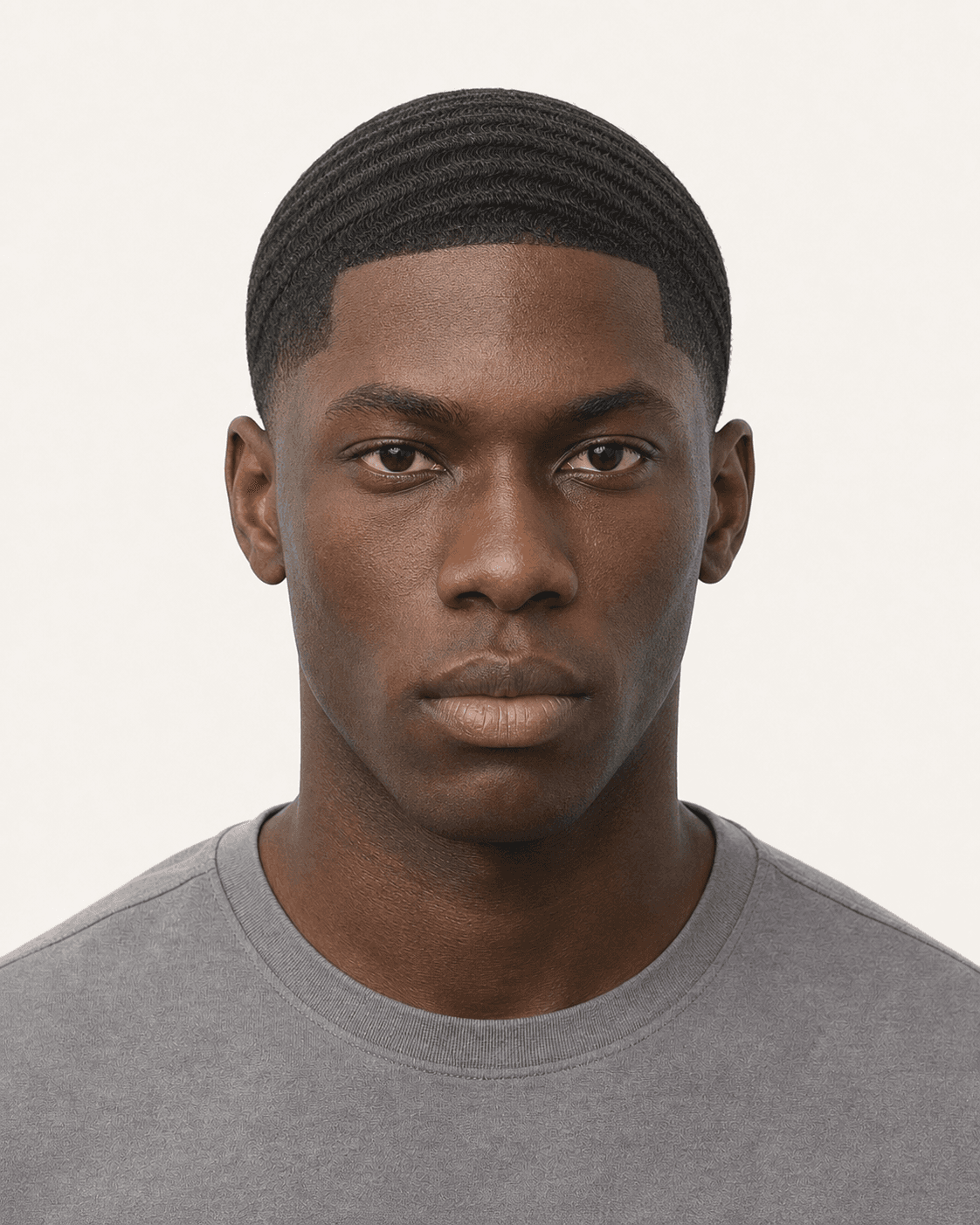
Annotated front construction map for 360 Waves with Low Taper. Front view of 360 waves with a low taper and natural lineup
Front
Approved publication view

Natural lineup and forward flow

The front view records the conservative hairline finish and the visible forward-moving wave ridges without implying painted enhancement.

01

Forward wave direction

Visible ridges move from the crown field toward the forehead

02

Natural lineup

The front edge is clean and follows a believable unpainted hairline
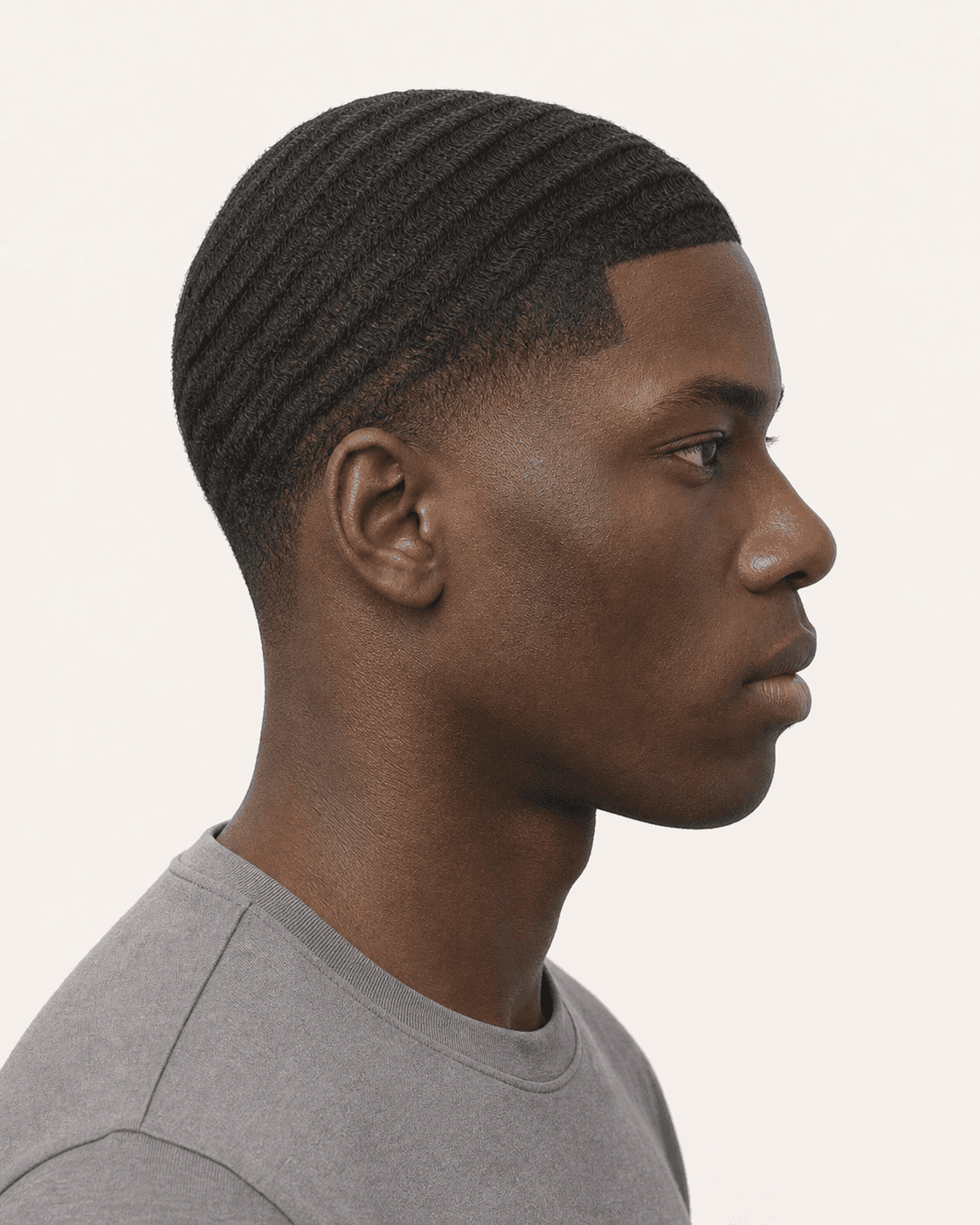
Annotated side construction map for 360 Waves with Low Taper. Side profile of 360 waves showing the wave flow and low temple taper
Side90°
Approved publication view

Wave field and low temple taper

The profile shows the patterned length retained above a low edge transition at the temple and sideburn.

01

Wave field preserved

Readable ridges continue above the transition rather than being cut into a high fade

02

Low temple taper

The shortest visible transition is confined around the temple and sideburn edge
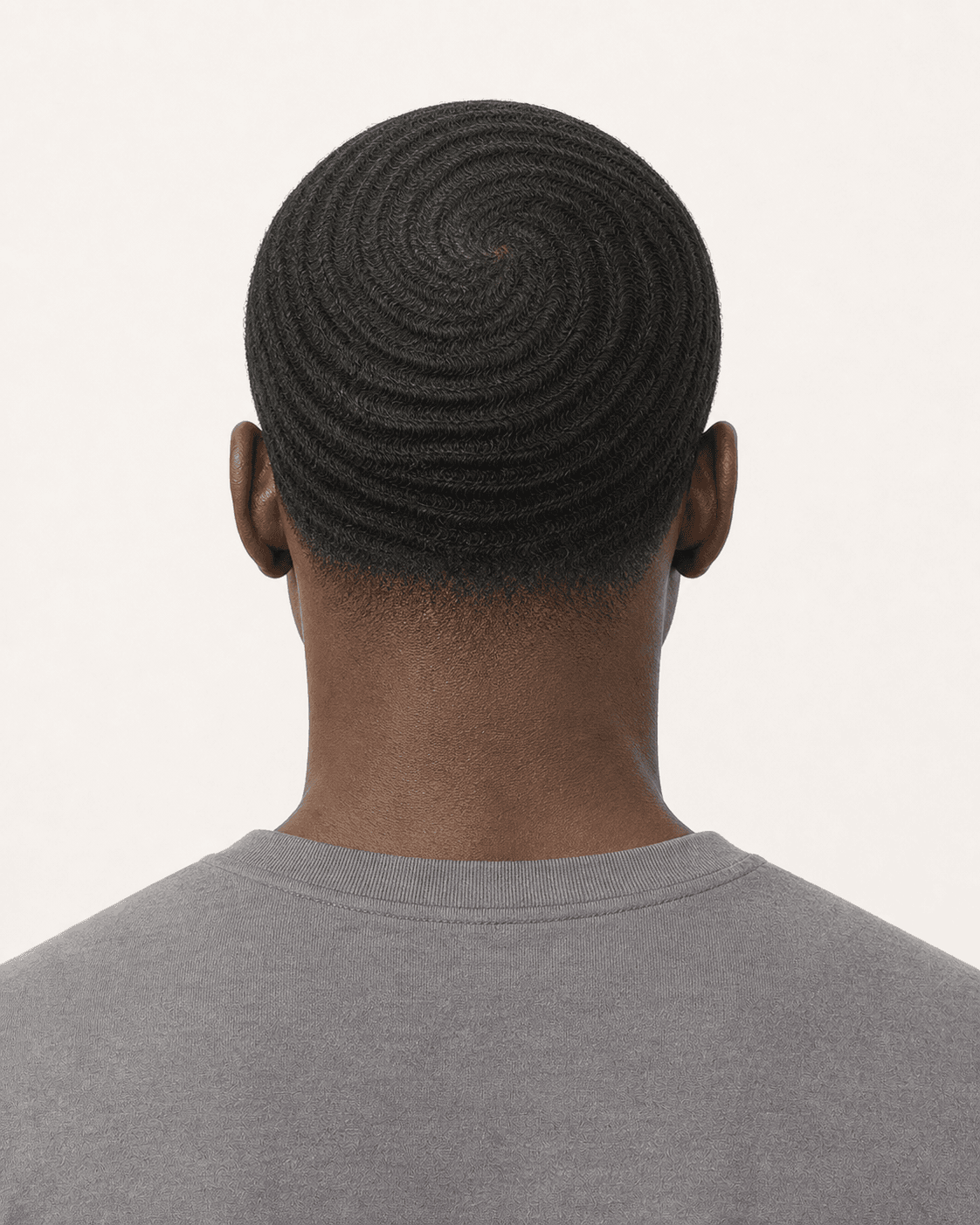
Annotated rear construction map for 360 Waves with Low Taper. Rear view of 360 waves showing a centered crown whorl and low nape taper
Rear180°
Approved publication view

Crown origin and nape finish

The rear view records a visible crown whorl, radial ridge continuity, and a low nape transition.

01

Crown whorl

The visible centre of the pattern anchors the surrounding radial flow

02

Low nape taper

The lower edge softens at the nape while the wave field remains intact above it

Pins locate the reference evidence; the numbered notes make the request legible in the chair. This is an original Hairqut communication diagram, not a universal service prescription.

Provenance: The diagram uses the locked approved publication views, which mirror the formal evidence package byte-for-byte. The overlays are deterministic HTML and SVG; a separate AI-generated diagram experiment remains internal and is not used on this page.

Reference result

Short natural hair with a visible crown whorl, concentric wave pattern, low temple and nape taper, and conservative natural lineup.

Starting-state gate

Existing wave development, curl pattern, crown direction, density, scalp condition, current length, and prior edge work determine what is achievable. A professional must assess them first.

Training-dependent pattern

The registered result combines a cut with an established grooming pattern. A haircut alone cannot promise immediate or identical wave development.

Full specification · evidence graded

What is known, what must be assessed.

Every field is marked by its evidence boundary. “Unknown” is intentional: the registry never invents hidden technique, anatomy, timing, or price.

Construction

Technical specification

Pattern origin
A visible crown whorl anchors the concentric pattern near the rear crown.
Visible
Direction
Ridges radiate from the crown toward the front, sides, and rear.
Visible
Overall length
Short and sufficiently uniform for readable ridges; an exact measurement is not recorded.
Recorded
Weight and density
Patterned density is retained through the main wave field rather than removed as a high fade.
Visible
Temple taper
A low transition is visible at the temple and sideburn edge.
Visible
Nape taper
A low soft transition is visible at the nape beneath the rear wave field.
Visible
Lineup
The front and temple edges are clean, conservative, and unpainted in the reference.
Visible
Guards
No clipper guard numbers are established by the approved evidence.
Unknown
Elevation
Not applicable as a supported descriptor for this short clipper-and-pattern reference.
N/A
Hidden sections
Exact clipper zones, lever positions, and blending sequence are not visible and are not specified.
Unknown
Neckline
The nape is softly tapered; a separate geometric neckline shape is not recorded.
Visible

Adaptation

Hair and suitability

Reference texture
Short, tightly curled natural hair in the registered result; this is a visual reference, not a guarantee for every curl pattern.
Visible
Wave history
The current degree of trained wave development must be assessed; cutting cannot create an established pattern instantly.
Assess
Density
Assess density and thinner areas before choosing length or taper placement.
Assess
Porosity
Not recorded; assess before selecting cleansing, conditioning, or styling categories.
Assess
Scalp condition
Assess irritation, sensitivity, flaking, lesions, or pressure intolerance before brushing, close edge work, or compression.
Assess
Growth direction
Natural crown placement and growth direction affect the achievable connections and must not be forced to match the reference exactly.
Assess
Face shape
No universal face-shape suitability claim is supported; personalize the edge and taper proportions to the person and goal.
Assess
Starting length
Enough patterned length must remain to preserve visible ridges; the correct cutting length varies by curl pattern and current training.
Assess

Service handoff

Booking service
mens_haircut_afro
Appointment duration
Not specified in canonical evidence; confirm during booking or consultation.
Price
Not stored in this style record; the current booking service controls price.

Professional requirements

Skills

  • Reading crown direction and preserving established wave connections
  • Choosing a cut length that retains ridge visibility for the current hair
  • Executing low temple and nape tapers without lifting them into the wave field
  • Conservative natural lineup work that avoids pushed-back corners and unsupported enhancement

Tools and product categories

  • Professional clippers, trimmer, and guards selected from the assessed starting length rather than a fixed record prescription
  • Clean wave brush with firmness selected for current length and scalp tolerance
  • Clean compression wrap fitted without excessive pressure
  • Light cleansing and moisture categories selected for the current hair and scalp

Safety and starting state

Confirm before service

  • Existing crown origin, forks, connections, and wave-development stage
  • Current length, curl pattern, density, growth direction, and scalp condition
  • Previous lineup placement, thinning areas, irritation, and service history
  • Current brushing, washing, product, and compression routine

Do not promise unchanged

  • Do not promise immediate 360-wave development from a haircut alone.
  • Do not cut below the length that preserves the person’s visible pattern without explicit informed agreement.
  • Do not push back the natural hairline or corners to imitate the reference proportions.
  • Do not perform close edge work or recommend abrasive brushing or tight compression over an irritated or compromised scalp.

Evidence and governance

Source package: os/hairqut-styles/registry/entries/HQ-STYLE-000048-360-waves-low-taper-lineup

Asset relationship: All four approved publication images mirror the formal package byte-for-byte.

Generated media: The approved style views depict a fictional AI-generated subject; the underlying generation model and request ids are unavailable. The on-page diagram is a deterministic overlay on those locked views.

Privacy: No real customer photo, identity, or biometric record is used in this Blueprint.

Booking handoff: The Blueprint links to the existing mens_haircut_afro service; duration, price, and availability come from the current booking flow.

Freshness

  • Asset quality and provenance package assessed 2026-08-01.
  • Blueprint geometry and full specification reviewed 2026-09-12.

Consultation

Confirm the pattern, edge restraint, and maintenance commitment

  • Assess the existing crown, connection points, wave direction, current length, density, scalp condition, and previous lineup before cutting.
  • Agree that the taper remains low and does not erase the wave field around the temple or nape.
  • Confirm a conservative natural lineup and explicitly avoid pushing the hairline back or adding pigment unless separately requested and disclosed.
  • Discuss the person’s current brushing and compression routine without promising a fixed development timeline.

Care plan

Keep the intent, not a fixed schedule.

  1. 1

    Daily or as individually tolerated

    Maintain the established direction

    Use a clean brush and the direction already established from the crown; frequency and pressure should be adapted to the hair and scalp rather than treated as a universal prescription.

  2. 2

    Between washes and appointments

    Protect moisture without heavy buildup

    Use only the amount and category of product appropriate to the person’s hair and scalp, and clean tools and compression wear regularly.

  3. 3

    Typically every 2–3 weeks for crisp edges

    Reassess taper and lineup

    The recorded range is a planning reference, not a promise; growth, scalp condition, edge recovery, and preferred finish determine the actual cadence.

Home kit

Product categories, not product pressure.

Direct

Clean wave brush suited to current length and scalp tolerance

Follow the established crown-to-edge direction without excessive pressure or abrasion.

Compress

Clean, well-fitting compression wrap

Use as tolerated to support the trained lay; avoid excessive tightness or prolonged use on irritated skin.

Condition

Light moisture category selected for the current hair and scalp

Avoid heavy buildup and stop or adjust if irritation develops.

These are care categories, not paid placements or a substitute for professional or medical assessment. No affiliate links, brand claims, fixed brushing count, universal product formula, or guaranteed wave-development timeline is present.

Professional brief

Hand this evidence-bound brief to your professional

Use the four approved registry views and the visible construction map to align on the result, then let the professional determine a safe cutting length, tools, taper sequence, and achievable pattern preservation from the current starting state.

  • The four approved registry views
  • The existing crown origin and wave connections
  • A short uniform wave field retained above low edge transitions
  • A low temple and nape taper rather than a high fade
  • A conservative natural lineup without pushed-back corners or painted enhancement
  • A scalp, density, growth-direction, grooming-history, and maintenance assessment
Book with this Blueprint

Blueprint v1.2 · reviewed . Every diagram pin and technical field was checked against the approved front, side, or rear publication view, the locked canonical record, and the formal evidence package. Exact guards, lengths, blend sequence, brushing counts, product formulas, development timelines, porosity, and unrecorded generation details were left unknown or assessment-required rather than inferred.

Canonical reference data

The source record behind the Blueprint.

These are the canonical attributes of the illustrated record. The Blueprint above translates them for a consultation; this section keeps the technical source explicit.

Length
Short and uniform
Pattern
Concentric 360 waves
Taper
Low temple and nape
Lineup
Clean, natural, unpainted

Style construction

Crown
A visible whorl anchors the wave pattern near the rear crown.
Wave flow
Ridges radiate continuously from the crown toward the front, sides, and rear.
Length
Short uniform hair preserves enough density for readable ridges without carved grooves.
Taper
A low transition refines only the temple, sideburn, behind-ear, and nape edges.
Lineup
The front and temple edge is clean but follows a believable natural hairline without pigment.

Quality assessment

Visible, not implied.

95/ 100

Publication threshold: 85. Assessed .

Identity consistency94
Haircut geometry95
View compliance100
Hair realism95
Anatomy realism95
Photography consistency95
Provenance completeness95
Why this record passed with warnings
  • Wave ridge spacing and contrast vary slightly with viewpoint and lighting, while the radial crown flow and low-taper construction remain continuous.
  • OpenAI built-in image generation was used; the underlying model identifier is not exposed by this surface.
  • AI-derived viewpoints are internally consistent illustrations, not proof that one physical subject was photographed continuously from four angles.

Registry provenance

100% AI-generated from scratch.

The four images are an intentionally matched fictional reference set made specifically for this Hairqut record. Fictional person; no real person or celebrity was used as a reference. The set passed deterministic asset checks and a separate visual consistency assessment.

Generated media record: OpenAI built-in image generation via ChatGPT. underlying model identifier not exposed.

Book your appointment