
Verified-angle construction map
Approved-view Caesar construction map
The approved front, side, and rear registry views are annotated only where the shallow straight fringe, compact forward top, retained temple density, low ear-contour fade, full occipital weight, and low nape transition are visible. The diagram does not prescribe guards, a measured fade height, blend sequence, top elevation, product formula, or facial-hair work.
3 publication views · 6 callouts

Shallow fringe and compact forward top
The front view establishes a short horizontal fringe close to the natural front boundary and a compact, broadly uniform top directed forward.
- 01
Shallow straight fringe
The visible front edge stays short and broadly horizontal without extending into a long, jagged, or heavily separated crop fringe
- 02
Compact forward top
The surface remains short, close to the head, and directed toward the forehead without an undercut, high volume, or disconnected crown
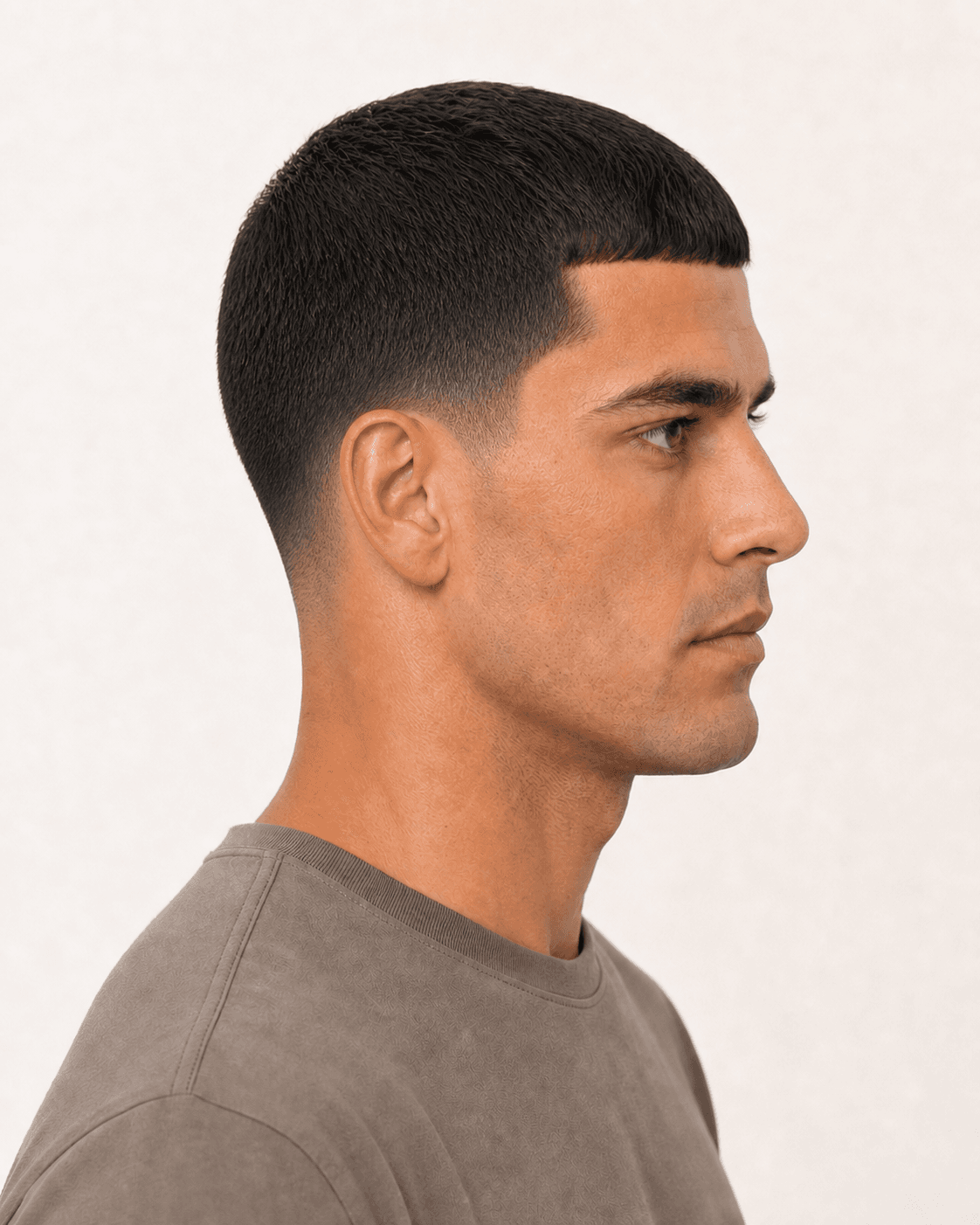
Temple reserve and low ear-contour fade
The profile keeps visible density through the temple and upper side while confining the strongest gradient to the lower ear contour.
- 01
Retained temple density
A dark, connected temple field remains between the compact top and the lower gradient rather than opening into a high fade or undercut
- 02
Low ear-contour fade
The shortest visible transition tracks the lower ear area and rises only into a low-to-low-mid boundary in the registered four-view set
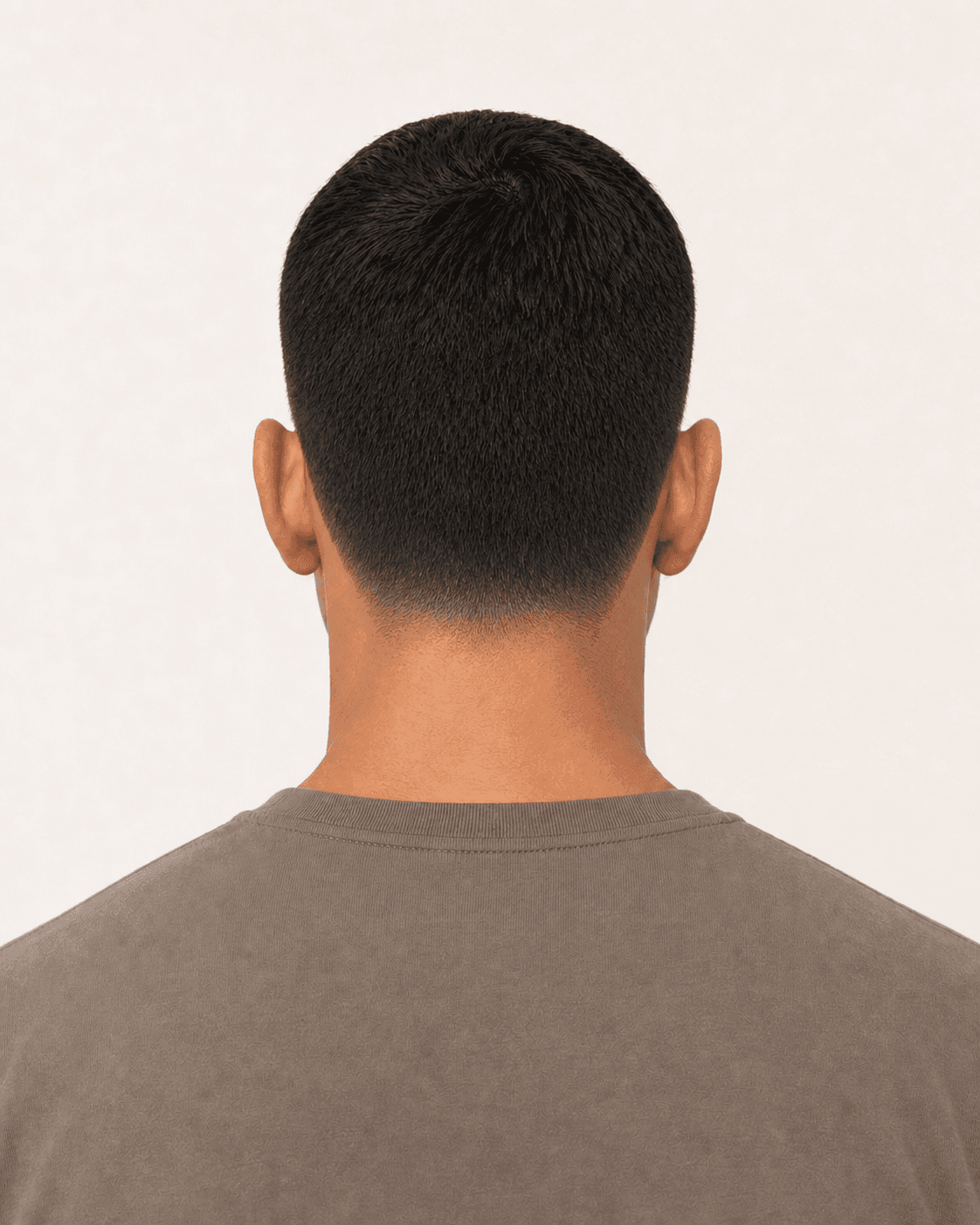
Full occipital weight and low nape transition
The rear preserves compact crown and occipital density while limiting the fade to the lowest rear and nape.
- 01
Full occipital weight
The crown-to-occipital field stays dark, connected, and broadly even without a high exposed gradient or disconnected shelf
- 02
Low nape transition
The visible fade softens only through the lowest rear into a natural neckline without a blocked edge, design, or painted enhancement
Pins locate the reference evidence; the numbered notes make the request legible in the chair. This is an original Hairqut communication diagram, not a universal service prescription.
Provenance: The diagram uses the locked approved publication views, which mirror the formal evidence package byte-for-byte. Its HTML and SVG overlays preserve those pixels and keep every label responsive and accessible. A newer generated raster passed all six exact labels and the low-fade boundary but remains internal because its raster output cannot prove approved-pixel preservation and critical labels would not remain semantic.